Demand Flexibility Service: Earn Rewards by Shifting Household Electricity Use
Great Britain’s year-round scheme can reward households for changing when they use electricity. Learn how events, providers and rewards work.
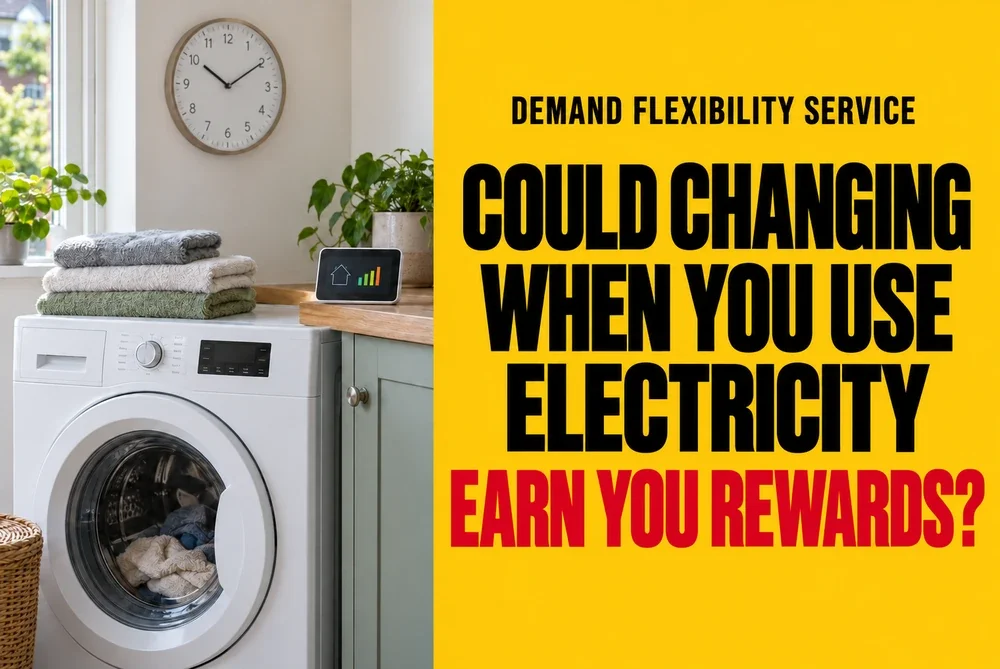
A planned load of laundry or a dishwasher cycle could earn a reward if you shift it to a time when the electricity system needs more or less demand. The Demand Flexibility Service (DFS) gives participating households in Great Britain a way to do that. The practical value depends on your provider’s offer, the event you’re invited to join and how much of your usual electricity use you can comfortably move.
DFS has changed since it began as a winter service. It has run throughout the year since 27 November 2024, and since April 2026 events can ask households to increase electricity use as well as reduce it. A further change on 7 October 2026 added a way to address limits on how much electricity the network can carry in particular places. That can make your location relevant: households in different areas may receive different invitations.
How the service works
Electricity use rises and falls during the day. When many households cook, run appliances or charge vehicles at once, demand can put pressure on the system. At other times, available renewable electricity may exceed demand. DFS events aim to help balance those conditions by asking customers to shift electricity use or change how much they use for a set period.
The National Energy System Operator (NESO) runs the service, but households join through an electricity supplier or another registered provider. Customers don’t apply to NESO directly for a reward. A provider sends the invitation, explains whether to use more or less electricity, and sets out its reward and participation terms.
This arrangement covers England, Scotland and Wales. Northern Ireland has a separate electricity system, so this DFS service doesn’t apply there. And even if your supplier takes part, you may still need to enrol in its scheme before you can receive invitations.
Getting enrolled and responding to an event
Start by checking your supplier’s app or website for an energy rewards offer. Household participation normally requires a working electricity smart meter that provides half-hourly readings. Your provider uses those readings to assess your usage during an event, and it may need some earlier readings to estimate your usual consumption.
If your supplier doesn’t have an offer that suits you, a separate provider may be an option. NESO’s registered providers list includes services for households and businesses. Check the domestic listings and the provider’s enrolment details. A provider’s registration doesn’t mean every household is eligible to join every offer.
After enrolling, watch for event invitations. They should tell you the session time, whether to increase or decrease usage, and what reward is available. Some services ask you to accept each event separately, so enrolling in the overall programme may not be enough. Invitations depend on system needs, location and provider rules; don’t count on a particular time slot or a set number of sessions.
Provider offers to check
Octopus Saving Sessions includes Power Down and Power Up events, with rewards paid in Octopoints. Joining requires Octoplus membership, a suitable electricity smart meter, and either a Direct Debit arrangement or smart prepayment. Customers need to opt in when invited.
Power Down rewards a reduction in electricity use against the amount you’d typically use. Power Up rewards an increase. The latter doesn’t mean that every unit used during the event is free: the amount measured and the offer’s terms determine the reward. Events may be limited by area, so a customer elsewhere may receive an invitation that you don’t.
Equiwatt offers another possible route for households with a compatible smart meter, including when their supplier isn’t participating. Its PowerDOWN events award app points for reducing use against expected consumption. Follow the event’s opt-in instructions; simply turning off an appliance doesn’t guarantee a reward. Some compatible equipment may be controlled automatically, while other offers require you to change your usage yourself.
Other providers named on NESO’s household list include British Gas, Hugo Energy and ScottishPower through Equiwatt. Offers, availability and requirements vary, so check each provider’s current terms. Don’t enrol the same electricity supply with two DFS providers at the same time. If you already use a service for an electric vehicle or home battery, check how it works alongside a DFS offer before signing up.
How rewards are measured
A reward generally depends on a comparison between your meter readings during the event and an estimate of what you would have used otherwise. That estimate is often called a baseline. Electricity use is measured in kilowatt-hours (kWh), the unit shown on your bill.
For example, if your estimated use for an event is 2kWh and your meter records 1kWh, the difference is 1kWh. At an imaginary rate of 50p per kWh reduced, that would mean 50p; a 0.2kWh reduction at the same made-up rate would mean 10p. These examples illustrate the calculation only. They aren’t current DFS rates or promises of payment.
Providers explain how they set a baseline. For instance, Octopus’s published method uses previous comparable days, with different reference periods for weekday and weekend events. The result is that two homes can make the same change but receive different rewards because their estimated usage differs.
Your starting habits also matter. If your household already uses very little electricity during an event, there may be little available to reduce. That’s simply a reflection of your normal routine. A household that usually runs several appliances at that time may have more scope to shift.
Check the cost as well as the reward
A DFS reward isn’t automatically a cheaper electricity rate. On a flat-rate tariff, running the same appliance at a different time generally costs the same in electricity; an event reward is an extra benefit. With a time-of-use tariff, the unit price changes by time, so moving a job can affect the bill as well as the reward.
For a use-more event, consider moving a task you already planned to do, such as a full dishwasher load, into the invited window. Running an appliance without a household need for it adds electricity use and could cost more than the reward. If you already have cheaper overnight electricity, compare its price with the event period’s price and reward before changing your routine.
One participant reports earning around £28 in account credit through Octopus during winter 2024. That’s an example of one person’s experience under the terms in place at the time, not a guide to what another household can expect. Today’s rewards depend on your usual use, what you can move, the event offer and how often you receive a suitable invitation. Some providers use points or bill credit rather than a bank payment, so check how rewards can be spent. Switching to a more expensive tariff for occasional sessions may not make financial sense.
Choose changes that fit your household
Appliances that don’t need to run at a particular moment may be easiest to shift. You could move a planned wash or dishwasher cycle to an event window, provided it fits your needs. If you need clothes ready the next morning, choose another time when you’ll be home and awake rather than leaving a machine running while everyone sleeps.
Keep essential medical equipment, fridges and freezers running. A small reward isn’t a reason to make your home uncomfortably cold or dark. The Centre for Sustainable Energy’s advice covers practical considerations for taking part.
There’s no fixed payment for every household, and earlier winter scheme figures shouldn’t be treated as a forecast for current events. The clearest approach is to check your provider’s eligibility and event terms, move a task you already planned where it makes sense, and let the meter readings determine whether the change earned a reward.