Older Households Gained Wealth as Younger Americans Lost Ground
Homeownership, rising financial assets and falling vehicle values widened the age divide in household wealth from 2022 to 2025.
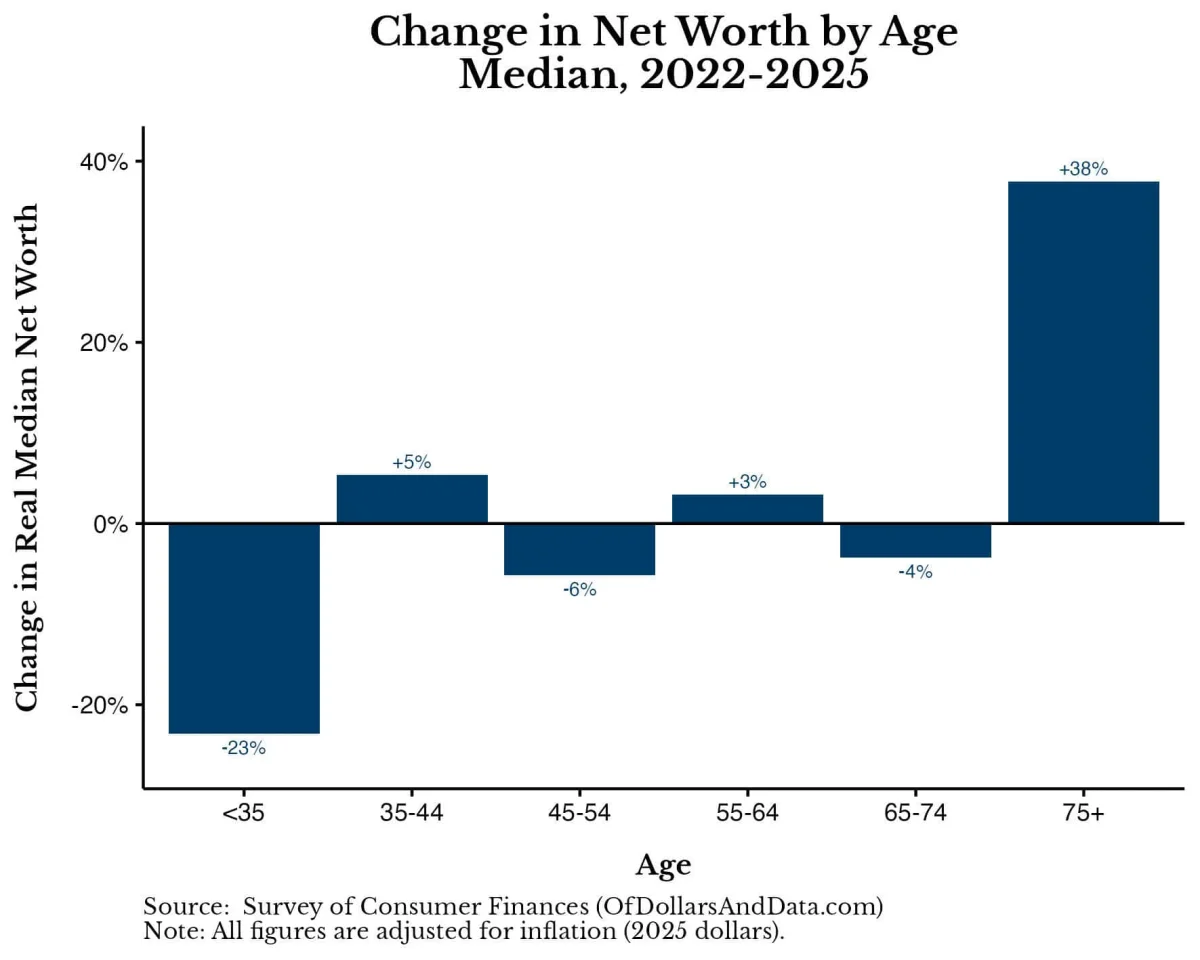
The wealth gap between younger and older U.S. households widened from 2022 to 2025, and the mix of assets each group owned helps explain why. Inflation-adjusted median net worth rose 38% for households age 75 and older, reaching $504,600. For households under 35, it fell 23%, to $32,820. The figures come from the three-year Survey of Consumer Finances, which offers a detailed snapshot of household finances.
Those headline changes deserve a little caution: the survey covers only a few thousand households, so results for a particular age group can be noisy. The broad direction is more useful than treating each percentage as exact. And the story isn't simply that every older household gained while every young household lost. Age, homeownership and the kinds of assets people held all shaped the result.

The age divide in the numbers
In 2025 dollars, median net worth for households under 35 dropped from $42,725 in 2022 to $32,820, a loss of $9,905. For households ages 35 to 44, it rose $7,931, from $148,069 to $156,000. The median for ages 45 to 54 fell 6%, while it increased 3% for ages 55 to 64. Households ages 65 to 74 saw a 4% decline, from $448,695 to $431,900.
The sharpest rise was among households 75 and older: their median increased $138,312, from $366,288 to $504,600. No other age group changed by more than 6% in either direction. These are medians, so they describe the midpoint of each group rather than the experience of every household.
Wealth matters, but age matters too
Looking across all households, the pattern resembles a K-shaped economy: the 20th percentile of net worth fell 11%, while households around the 70th percentile and above saw gains of about 11% or more. That suggests higher-wealth households pulled ahead as lower-wealth households slipped back.

But age changes the picture. Among households under 35, net worth fell across most of the wealth distribution; the 80th percentile was an exception, though that result may reflect sampling variation. Young households near the top weren't spared: the 90th percentile had net worth of $351,000 in 2025, down 14% from 2022.

Among households 75 and older, net worth rose across most of the distribution, with the bottom 10% as the exception. The 20th and 30th percentiles gained 26% and 45%, respectively. A richer group of baby boomers aging into the 75-plus category accounts for some of the overall increase. To reduce that effect, consider the cohort that was 72 or older in 2022 and 75 or older in 2025: its median net worth rose from $418,720 to $504,600, a 21% gain.

Similar wealth levels could also move in opposite directions. The 2025 net worth of young households at the 90th percentile was close to that of older households at the 40th percentile. Yet the young group lost 14%, while the older group gained 38%, partly because of the changing makeup of the age group. That points to the assets households held, rather than wealth alone, as a key part of the explanation.
Homes, financial assets and cars
For the middle 50% of households in each age group, the main drivers were housing, financial assets and vehicles. Older households saw gains in primary residences, retirement accounts and other assets. Younger households experienced declines in housing wealth, vehicle wealth and retirement accounts.

Homeownership is the clearest divide. Young households have been much less likely to own a home than those 75 and older, a pattern that held throughout the six years shown in the survey. Among households under 35, the homeownership share fell from 38.5% in 2022 to 35.6% in 2025. About 64% of young households did not own a home.

That shift matters because the median net worth of young homeowners was about $184,000, compared with $12,000 for young renters. Renters themselves weren't necessarily losing ground: their median net worth reached $12,000 in 2025, the highest reading in the survey's data back to 1989. But when fewer young households own homes, fewer share in the wealth associated with homeownership.

The asset mix also shaped the impact of market changes. In 2022, stocks, funds and retirement accounts made up about 9% of assets for the middle 50% of young households, compared with 16% for the same slice of households 75 and older. U.S. stocks then rose roughly 48% after inflation from 2022 to 2025, giving older households a larger share of assets that benefited from that rise.
Vehicles made up about 20% of assets for the middle 50% of young households in 2022, versus less than 6% for older households. Used car prices, which had surged during the pandemic, later fell. The median value of vehicles owned by young households dropped 21% from 2022 to 2025, while the figure for older households was essentially flat, down 1%. The price series is available from FRED.
A retreat from a pandemic-era jump
The 2022-to-2025 decline looks less dramatic when set beside the previous three years. Median net worth for households under 35 rose from about $18,000 in 2019 to nearly $43,000 in 2022, a 140% increase, before falling to about $33,000 in 2025. For households 75 and older, net worth rose a more modest 13% from 2019 to 2022, followed by the 38% gain in the latest period.

The precise reasons for the young households' pandemic-era increase aren't known. Stimulus checks, paused student loan payments and rising asset prices may all have contributed. The jump was the largest recorded for this age group. With payments resuming and those checks no longer arriving, some reversal could reflect a return toward more typical conditions. Still, that context doesn't erase the pressure facing younger households.
Why timing can matter when helping family
The past three years rewarded households that owned assets that rose or held their value. Older households were more likely to own homes and held a larger share of financial assets. Younger households were less likely to own homes and had more wealth tied up in vehicles that lost value.
For younger adults, building wealth can also depend on income and access to housing. The source points to a difficult job market for recent college graduates and housing affordability at its weakest point in 40 years. Those conditions may make it harder for young households to build wealth through earnings and homeownership, even if their finances look stronger than they did before the pandemic.
That raises a practical question for families with resources to share: does help arrive when it can make the most difference? Inheritances often come when recipients are in their 50s or 60s. Earlier support could help with a down payment, ease rent costs by letting an adult child live at home, or take the form of advice, useful connections or mentorship.
The source also describes annual gifts of $19,000 per recipient, or $38,000 for a married couple. Those figures are presented as the annual gift tax exclusion; anyone considering a gift should check the applicable tax rules for the year. Financial help only makes sense when the giver can afford it. For families who can give comfortably, the timing may shape how useful that support is.
Household wealth doesn't move on age alone. Homeownership, financial investments and the value of everyday assets all influence the result. The clearest takeaway from 2022 to 2025 is that younger households' wealth declined while older households' rose, and the assets behind those changes offer a useful guide to where family support may matter most.